 By Tyler Durden
Pix Moving, a Chinese automobile startup using artificial intelligence (A.I.) to design vehicles and convert the blueprints into instructions for 3D printers, isn’t afraid of President Trump’s trade war and has utilized technology to bypass tariffs, reported Nikkei Asian Review.
Angelo Yu, the founder of Pix Moving, has outsmarted the most powerful country in the world: the U.S., as A.I. designs vehicles, uploads the blueprints onto the cloud and sends the instructions to 3D printers that can be based anywhere in the world.
“We don’t export cars to the U.S.,” Yu said. “We export the technique that is needed to produce the cars.”
Pix has gained attention from two major automakers, Volvo and Honda motors. Yu told Nikkei that if Henry Ford was still living, he would be using A.I. and 3D printers to produce automobiles.
“If Henry Ford were still alive,” Yu said, “I believe he would have also built cars using A.I.”
Yu’s startup could be the solution for Chinese manufacturers to bypass President Trump’s tariffs.
To reduce the number of parts needed to make an automobile, Yu and his team turned to an A.I. technique known as generative design, which is a program that entirely uses A.I. to design the vehicle with some human inputs such as car size and maximum weight. Many other inputs could go into the design, but from there, Yu said the computer does all the work.
Siddharth Suhas Pawar, a mechanical engineer at Pix, told Nikkei he was often “surprised” by the A.I.’s suggestions.
“I would have never thought about making a car that way,” Pawar said. Vehicle designs by A.I and humans showed A.I
were far more detailed with revolutionary designs.
“I would have never thought about making a car that way,” Pawar said. Vehicle designs by A.I and humans showed A.I
were far more detailed with revolutionary designs.
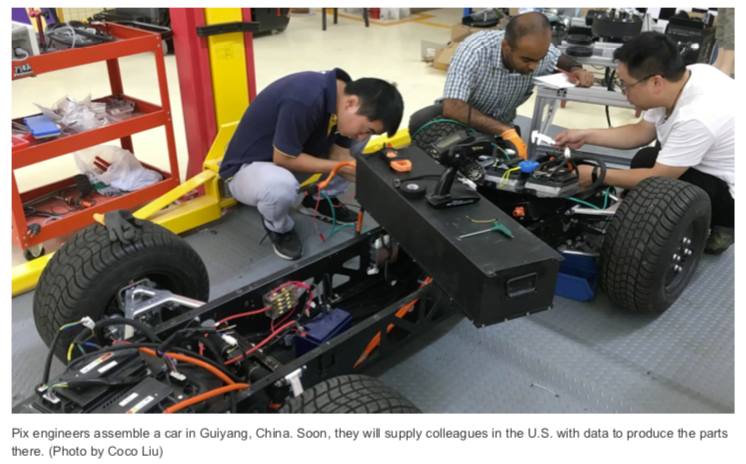
Once A.I. designs the vehicle, Yu’s team signs off on the final design. Uploads it to a cloud where it can be sent as instructions to 3D printers.
For instance, the chassis, A.I. reduced the number of parts from thousands to hundreds. A.I. can work out the clock, designing new components and reducing parts, making the design of a vehicle in only 12 months, versus 36 months for a traditional automaker.
Since Pix is data-driven, the company can quickly replicate factories that would only be exclusive to China, anywhere in the world, at a moments notice. If President Trump was targeting Chinese automobile companies with tariffs, Yu could quickly shift production lines anywhere, anytime, with literally at the flip of a switch. If he had to move production to Japan, he could do it. He could even move production to South Korea, the U.S., Vietnam, and or even South America.
“Pix has a unique and interesting approach to problem-solving,” said Matt Lemay, a specialist at Autodesk who invited the Chinese startup to join the program. “Pix’s vision of the future, on not just autonomous vehicles but also new methods of design automation and smart manufacturing, makes them a compelling partner.”
Unlike large automakers, whose production lines are for mass production, Yu said his 3D printers could handle small batches. In April, he received his first order from a Texas company who wanted a self-driving truck.
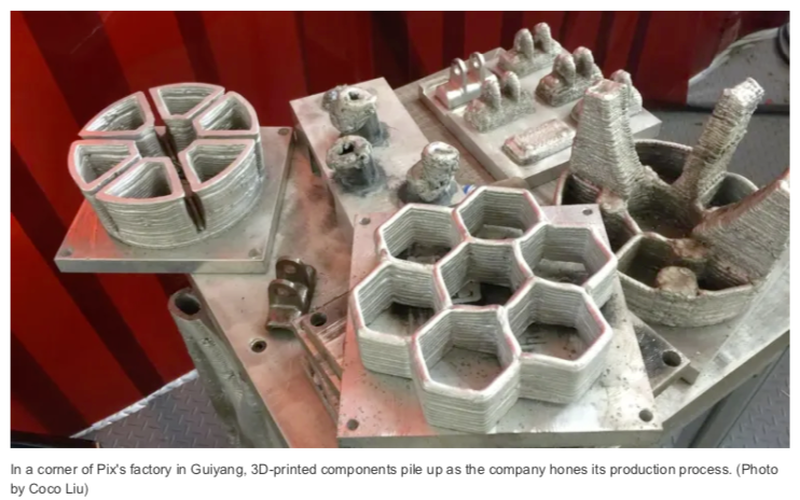
Yu said the design of the truck should be completed in the near term. He said his company had secured a factory in an abandoned warehouse in San Francisco, where A.I. computers in China are wrapping up on the final design of the vehicle. Once the design is completed, engineers will sign off on it, and upload it to the cloud, where 3D printers in San Francisco will receive the instruction to start printing the truck.
“The U.S.-China trade war will motivate more and more Chinese manufacturers to embrace smart manufacturing,” Yu predicted. “In the future, international trading will no longer run on cargo but on the cloud.”
And just like that, President Trump’s trade war is absolutely worthless — as per one Chinese company, utilizing A.I. and 3D printing to skirt around economic duties. The world will move forward, technology and the human will to adapt will outsmart dinosaur governments. It’s only a matter of time before big automakers get a hold of this technology and process.
This article was sourced from ZeroHedge.com
The Counter Markets Newsletter will show you how to live free of government and corporate tyranny while growing your wealth and liberty
Members paid $250 to access the powerful tools, strategies, and resources inside this newsletter...
...but we'll give you your first issue absolutely FREE
Here's what's inside:

You'll also receive our exclusive daily emails with tips, tactics, and promotions for living free in an unfree world.
Enter your name and email below to get your issue of the Counter Markets Newsletter for FREE!